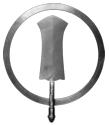
Re: TAKSALI Kirpans now in surrey
gursikha(n) kee har dhooR deh · 11 Nov 2004
how much?
Don't buy the hype
respectfully · 11 Nov 2004
Why are taksali kirpans considered so great? In my opinion, they are just barely better than the stainless steel kirpans on the market.
The only thing they have going for them is that they are made from carbon-steel aka sarbloh but the quality of that sarbloh is sketchy - what is the source of that sarbloh and how well is it tempered if at all?
Other than that, they are absolutely pitiful as shastars. Ergonomically, they suck - don't allow for great handling. Blade wise, the proportions are all messed up - just take a look at that ridiculous spine - what are we going to use this kirpan for - a wood-working chisel?
There is a purpose for a weapon. Are these taksali kirpans designed to be cutting/hacking weapons, slashing weapons, or thrusting weapons? The design is absolutely horrible and they are much too heavy to have been smithed by someone who knows what they are doing. It seems that who ever designed this kirpan didn't put a lot of thought into its function.
Don't be cheap when it comes to buying shastars - save up your money, $10 here, $20 there, and in a few months or maybe a year, you will have enough money saved up to purchase a real shastar, something worthy of being carried by an Akali fauji.
respectfully,
Respectfully
Re: TAKSALI Kirpans now in surrey
respectfully · 12 Nov 2004
Dear 'respect',
My comments were not directed at any person, group, or ideology but towards a piece of metal being put forward as a kirpan. As such, my comments, and I think they were very clear, were directed to the material, shape, and function of the 'taksali' kirpan.
Now to the question of respect. Is a knife-shaped object a kirpan in the hands of Muslim? No. Would a 'taksali' shastar be a kirpan in the hands of a Christian? No. This shastar becomes a kirpan in the hands of Gursikh. Until that time, it is merely a weapon. Respect for the CONCEPT of the kirpan should be inherent in every Sikh.
However, Guru ji did not give us the kirpan to serve as a mere symbol only; the kirpan has a function - it is a shastar.
Therefore, there are some qualities a good weapon should have and some it shouldn't have.
As such, the statements from my previous post remain standing: pitiful, horrible and definitely, "whoever designed this Kirpan
didnt put a lot of thought into its function".....
My like or dislike has nothing to do with it - the taksali kirpan is simply not a good shastar - this is not a subjective assessment but an objective one.
That Sant Gurbachan Singh ji Khalsa gave his ok to start making these kirpans means nothing to this discussion - you are appealing to authority instead of addressing the weakness of the taksali kirpan as a shastar.
Moreover, just because Sant ji gave the ok, it doesn't mean he knew anything about what qualities a good shastar should have or that those who designed the kirpan knew what they were doing.
The only thing we can judge is the product itself and I am not about to put the 'taksali' kirpan on some kind of pedestal when it doesn't deserve to be on one.
Sikhs were not known for being the best dressed or for eating the richest food but our horses were strong and our weapons were of good quality.
Where we put so much effort into other things, it wouldn't hurt to put in a bit of effort into acquiring a proper shaster for a kirpan and not blindly donning a poorly manufactured hunk of metal just because everyone else says its a good weapon.
respectfully,
Respectfully
respect wrote:
> whoa whoa...take it easy there "respectfully"....using words
> such as PITIFUL, HORRIBLE, saying "whoever designed this Kirpan
> didnt put a lot of thought into its function".....thats not
> very RESPECTFUL...
>
> Sant Gurbachan Singh Ji Khalsa Bhindranwale gave the
> Bhindranwala Jatha his ok to start making Sri Sahibs for the
> Panth.
>
> just because you dont like it....doesnt mean its not a good
> shaster....and plz show a little respect and dont use those
> mean words that were mentioned above.
>
> thank you. Guru Ji plz bless even more Kirpaa
Re: TAKSALI Kirpans now in surrey
respectfully · 12 Nov 2004
Dear jss,
The first thing to consider is how 'brave' you are in breaking free from conventional thinking.
The shape of the kirpans we see today is rather modern - a shape not born out of the need to suit warriors for battle, for life and death situations but for ease of convenience and manufacture.
The kirpan, the REAL kirpan that Guru ji commanded us to wear was the tulwar. Going by that, none of us today are fully adhering to the 5ks with the exception of a few old-school nihangs.
A little general history - it'll be general because I can't find the notes I took but I'll try to paint you a picture.
After the Anglo-Sikh wars, with the Punjab under British control, Sikhs were disallowed the wearing of any weapons. Due to some agitation, and in my opinion, the usefulness of the Sikhs to the British cause, the restriction was relaxed and the British allowed the Sikhs to wear a 6 inch representation of the kirpan (kirpan meaning full-sized tulwar).
After some time, with the Sikhs actively helping the British, the British threw away the 6-inch restriction; however, by that time most Sikhs were so used to wearing the 6 inch representation, they didn't go back to the real kirpan. As time went by, the 6-inch representation became the norm.
Why am I giving you this history? So you don't feel compelled to wear the same shaped kirpan being manufactured in India today - there is nothing, absolutely NOTHING compelling Sikhs to wear this one type of design.
That said, when looking for a shastar design must fit function ie. the pesh-kabz: terrible at cutting and slashing but excellent in thrusting - it was designed with the purpose of piercing chain armour and did so wonderfully.
I won't go deep into concepts like profile, distal taper, cross-section, weight-distribution in this post but in general, a slashing/cutting weapon will be thinner in thickness and wider in breadth of blade. These are generalities - someone may prefer a little weight to their cuts and have a thicker spine, thus trading off on pure cutting ability but adding to durability and rigidity. Someone else may prefer a weapon with a certain degree of thrusting ability, requiring new considerations as to design.
I'm not giving you a hard and fast answer because there is so much variability regarding personal choice. For example - even though many knife fighting instructors recommend a weapon that has its weight towards the handle/hilt, I prefer a more forward-weight kirpan - I give up a certain amount of manouverability and speed but I like the dynamics better, as well as the greater power.
Regarding quality of steel -
With swords, it is almost a definite that it should be made of carbon-steel (sarbloh); with knives, many smiths have done great things with stainless steel. However, sarbloh has a certain appeal to it and I prefer them, so lets go with that :)
So now you're looking for a sarbloh kirpan - what next? Has the dagger/knife/kirpan been made by stock-removal or forging? For our purposes, don't worry about this step but move on.
Has the steel been heat-treated? This is THE key in making quality swords and somewhat less of a concern with smaller shastars - I still would want to know about the heat-treatment. Very basically, in a shastar, especially a sword, you want to have some measure of hardness (in order to maintain sharpness and rigidity) and some measure of softness and flexibility (so it doesn't snap under impact or become too brittle). In a newer made piece, ask for detail regarding heat-treatment. With older pieces, antiques - assume a good heat-treatment - those old smiths knew what they were doing.
Where can you find good shastars? It's going to require work on your part - I'll give you the names of a few middle-men who deal in older shastars but to save money, you may want to try finding out how different auction-houses in N.America, Britain, Europe work. If you happen to go to India, try hitting up some of the Nihang deray and see if you can get some recommendations. Rajasthan has some terrific smiths and weapons are sold in many of their markets but you have to be careful to educate yourself first so you don't get ripped off in terms of price you pay and quality of weapon.
With the below companies, you'll have to check from time to time as stock does change. Also, keep in mind that there will be a fair mark-up in the price you pay with these below mentioned companies but I can recommend these companies with some degree of confidence. Especially ARtzi from Oriental Arms - very knowledgable person.
Ebay is another option but be very careful - mostly rubbish out there. Good luck in your search!
respectfully,
Respectfully
some names:
http://www.oriental-arms.com/
www.akaalarms.com
Liongate carries some fine pieces: http://www.antiqueswords.com/
Re: TAKSALI Kirpans now in surrey
respectfully · 12 Nov 2004
Dear 'sad' -
I read your apology to the Administrators and so will try to keep my post short as they hit most of what I would have wanted to say.
To clarify, my posts have nothing at all to do with the Taksal - Guru ji has blessed me with some very basic/rudimentary knowledge of shastars and I wish to share this with others. I am the first to admit I have much to learn in the area of shastars, steel, and smithing but I probably know more than most on this forum.
So why bring up this criticism? Because Sikhs are soldiers and the quality of our kirpans is absolutely deplorable! Not only do we, once a people reknown for their martial skills, no longer recognize the qualities a genuine shastar should have, but we have no desire to learn. We are happy in our ignorance, wearing cheap imitations of real weapons.
As to my allegience to the AKJ or Taksal - I think some of my previous posts show that I belong to neither group. I made a conscious decision years ago to not join any one group.
And why would I join the AKJ or the Taksal, which are secondary level, sub-groups in the Khalsa Panth, when I belong to the main parent body itself ? :) To the sensitive types out there, I'm joking! (sort of.....)
respectfully,
Respectfully
Re: TAKSALI Kirpans now in surrey
Niranjan Singh · 12 Nov 2004
There are about 4 or 5 major small Kirpan types produces in Punjab today :
(1) Ratovaal walee Kirpan
One of the oldest makers. Most old Kirpans worn by Bhai Randhir Singh
Baba Gurbachan Singh are these types.
Famous for making 100% Sarb-Loh blades
and straight 100% Sarbloh/wooden sheaths.
Sheath metal is usually thick with noplating.
Sometimes called AKJ Kirpan, because of Ironsmith's association with
AKJ.
(2) Patialay walee Kirpan
Produced by Budha-Dal associated Ironsmiths.
Sarb-Loh Blade, and simple Sarb-Loh/wooden sheaths.
Sheath metal is usually thick with noplating.
(2) Bhinder-Kalan walee Kirpan (the original "Taksali Kirpan")
They started calling them "Taksali Kirpan" recently, they used to be
referred to as "Kirpan from Bhindreen", etc.
Famous for the curved tip sheaths, but sheaths are made from thin
metal, plated to look like steel.
(3) Mehta Chauk walee Kirpan (a copy cat of Bhinder-Kalan Kirpans)
Kirpan blade is identical to the above Kirpans, but the sheaths are
inferior to the ones from Bhindreen.
(4) Amritsar walee Kirpan
Typical all Steel sheaths and blades or brass/copper sheaths.
Made by various Kirpan factories.
The Ratovaal & Patiala Kirpans are the best quality. Both of their craftsmanship are the best. They don't do any plating, and use thick sarbloh metal for the sheath, and don't have the unnecessary curve/angle on them as the "Taksali" ones do. They look more like the puratan Kirpans than the others. Also, the handles are more balanced in the Ratovaal design. The Bhinder-Kalan are next, very good workmanship, but the handle is too thick and not balanced, and the sheath is a bit too curved for my taste. Otherwise, and excellent shashtar.
Here is my choices in order of quality/design/look & feel :
(1) Ratovaal - Patiala
(2) Bhindereen
(3) Mehta Chauk
(4) Amritsar
Re: TAKSALI Kirpans now in surrey
respectfully · 12 Nov 2004
Dear seeker,
In my humble opinion, you can use a wide variety of materials in the grip. You will find puratan shastars with hilts ranging from wood, to wood covered with leather, to ivory, to bone, to sarbloh. (aside: Puratan kirpans/tulwars were not made of one piece construction but were made by joining the hilt to the tang of the blade via some form of resin - essentially a type of glue.)
On the kirpan that you've mentioned, if the hilt is in the general shape of the taksali kirpans, a para cord wrap would work really well. Your idea of tying something around the handle is excellent...
Do a search on Google and you will find a few different ways to do the paracord/para-cord/para cord wrap. Best of luck.
respectfully,
Respectfully
Re: TAKSALI Kirpans now in surrey
Searching for Tat · 12 Nov 2004
Look at Guru Sahib shasters: - there are so many about like at Anandpur Sahib.
They are nothing like these modern kirpans. Most were made in places like Iran and are very functional. The metal were so strong and were Damacus Steel. I have a taksali kirpan, but agree they are not very functional. I had to get mine especially sharpened.
I am on the look-out for better shaster. Definately better shasters need to be made. I like the style of the Victorinox style, but they seem commercial. But things need to go more that way. Why can we not get good Damacus steel shasters anymore?
P.S> . - Admins are right, they did stop alot of posts. They stopped many of my responses to khalistani, to finish the debate. DT youth need to stop being so paranoid.
Re: TAKSALI Kirpans now in surrey
respectfully · 13 Nov 2004
Dear 'Searching for Tat',
I think what you are referring to is damascus steel and not damacus.
Damascus steel can be of two kinds: wootz and pattern-weld damascus.
By and large, no one knows how to make wootz/ukku steel anymore although some western smiths and at least one russian smith claim to have rediscovered the method. Wootz steel came from India, south India if I'm not mistaken, and is also called crucible damascus. Essentially, the smiths of old, thru the quality of steel they used and/or a special smithing method, were able to produce a tough, flexible, sword that retained a wicked cutting edge. One type of steel was used to make wootz/ukku steel and smiths were able to create patterns within the blade itself. This wootz was widely exported and in some areas of the world came to be known as damascus.
The other, more commonly found (though still relatively rare) damascus is pattern-weld damascus. Usually two different types of steel are twisted and welded together, resulting in some beatuful patterns in the blade. However, beauty was not the reason smiths used this method of sword making - function is the key. Due to lower quality steels available, smiths found that combining two different types of steel in pattern-weld resulted in a better blade.
Today, modern steels are excellent and superior to the quality of steel found in the past. As such, there is no real need to search out pattern-weld blades as far as function goes - today's monosteel (one type of steel) used in blades by good smiths is of great quality. Moreover, monosteel blades are significantly cheaper to have made than damascus steel blades due to less work involved. So what is the trade off? Today, the trade off is aesthetics, beauty - I am luck to own a pattern-weld damascus kirpan with a 'Mohammed's Ladder' pattern - simply gorgeous. Function-wise, however, there probably isn't much difference between it and a good monosteel blade.
To further complicate the matter, although damascus steel blades used to indicate high quality, that is not neccessarily the case anymore. As I mentioned before, the key is the heat-treatment. A smith may make a damascus blade with a pretty pattern but if the heat-treatment is not done or not done properly, you end up with an inferior blade. You can find plenty of nice-looking damascus blades, daggers, swords etc coming out of Rajasthan under the name of various companies but while the blades look pretty, some knowledgeable buyers have criticised the steel for lacking proper heat-treatment - this may not be the case with all modern rajasthani blades on the market but 'buyer beware' is a good saying to keep in mind.
Still, if I was to go to India, I would definitely make a trip to Rajasthan and get a hold of an expert in the field who lives there to accompany me to some of the markets. High quality shastars are being made by a few select smiths but they would much rather sell you garbage for a high price if you look like you don't know what you're doing.
In the meantime, I recommend starting a 'kirpan fund' for yourself - you never know when a great deal on a new or antique piece may come your way.
My apologies for the long posts - I love shastars and once I get started, I find it hard to stop. I'll try to keep future posts to a shorter length.
bhul chuk maaf karni,
respectufully,
Respectfully
Searching for Tat wrote:
> Look at Guru Sahib shasters: - there are so many about like at
> Anandpur Sahib.
>
> They are nothing like these modern kirpans. Most were made in
> places like Iran and are very functional. The metal were so
> strong and were Damacus Steel. I have a taksali kirpan, but
> agree they are not very functional. I had to get mine
> especially sharpened.
>
> I am on the look-out for better shaster. Definately better
> shasters need to be made. I like the style of the Victorinox
> style, but they seem commercial. But things need to go more
> that way. Why can we not get good Damacus steel shasters
> anymore?
>
> P.S> . - Admins are right, they did stop alot of posts. They
> stopped many of my responses to khalistani, to finish the
> debate. DT youth need to stop being so paranoid.